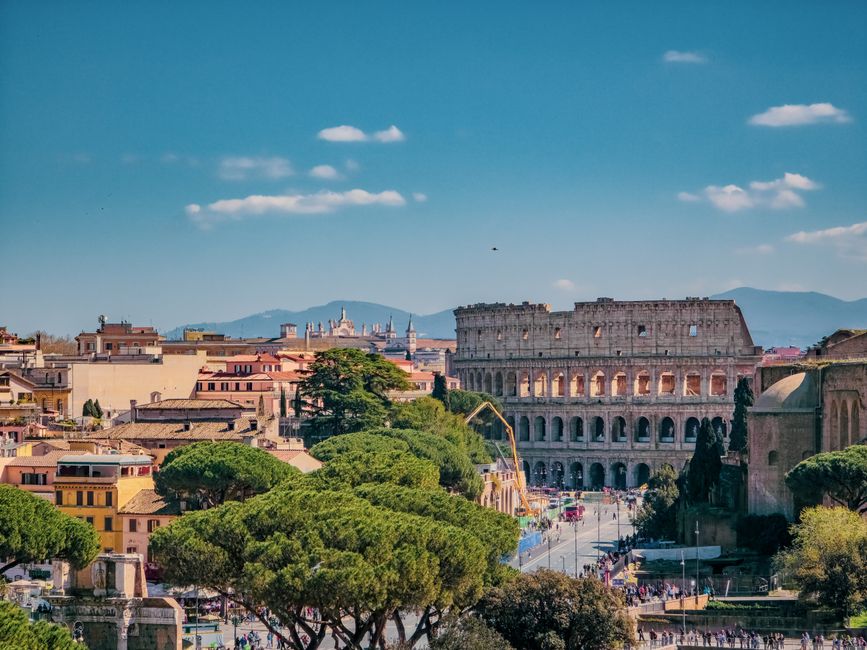
The first clue is often sensory: espresso at the bar, stone still cool in a shaded piazza, the sudden gleam of water at the end of a narrow lane. Italy tends to arrive this way before it explains itself. That is why these five cities work so well together. They are not a ranking so much as a set of doors into the country’s character.
A city in Italy often announces itself before you have fully arrived: the rumble of a Roman bus beside a ruin, the echo of footsteps under a Florentine arcade, the hush of water against stone in Venice. These five cities work best not as a ranking, but as five different entrances into the country.
Classic First Trip or Broader Italy?
The classic first itinerary—Rome, Florence, Venice—still holds because it delivers Italy in three instantly legible forms: imperial scale, Renaissance refinement, and dreamlike spectacle. Social recommendations for first-timers repeatedly return to that trio, and not only out of habit; travelers describe Rome as history all around you, Florence as the most approachable art city, and Venice as a place that can set the emotional bar improbably high from day one. That consensus is easy to understand when Rome remains one of Europe’s most visited urban destinations, with tourism data underscoring its enduring pull via
Choose the Italy That Matches Your Curiosity
If your memory of Italy is likely to arrive in fragments—a train pulling into Santa Maria Novella, light lifting off a Venetian canal, the clink of aperitivo glasses in Milan, the first deep bowl of ragù in Bologna—that is also the right way to choose it. These five cities are not competing answers. They are five distinct expressions of the same country, each sharpening a different appetite: Rome for scale and continuity, Florence for artistic concentration, Venice for atmosphere, Milan for modern energy, Bologna for lived-in food culture and intellectual ease.
remains the essential overture, where layers of empire, church, and daily city life sit almost impossibly close together; it is also the country’s capital and largest city.
sharpens the picture through Renaissance art, compact streets, and a scale that lets history feel walkable rather than distant. Venice, still one of Italy’s enduring classics, offers the singular experience of a city built on water, where beauty and fragility are part of the same atmosphere.
Then the view widens. Milan adds modern rhythm: finance, fashion, design, and one of Europe’s most visited urban centers, reminding travelers that Italy is not preserved in amber. Bologna deepens the story differently, with porticoed streets, a serious food culture, and the lived-in ease many repeat visitors start seeking out.
Taken together, these cities form a convincing first portrait of Italy: ancient and inventive, ceremonial and intimate, polished and deeply regional. Start here, and the country begins to reveal not one identity, but several—each worth returning for.
Rome
is for first-timers, history lovers, and anyone who wants scale. As Italy’s capital, it folds antiquity, Baroque spectacle, and everyday street life into the same afternoon;
notes Rome’s place among Europe’s most visited cities. Expect energy, traffic, and crowds that reward early starts.
Florence suits travelers who want concentration rather than sprawl: Renaissance art, compact streets, and a pace that is busy but more legible than Rome. Several travel roundups place it near the top for exactly that cultural density, including Twinkle Stars Tours and Janice Rohrssen’s guide. It is ideal for a shorter stay, especially if you like museums, design, and easy Tuscany day trips.
Venice is best for atmosphere. Nothing else in Italy feels remotely similar: no cars, shifting light, and neighborhoods that become quieter once day-trippers thin out. It is also one of the places where timing matters most. Peak season across Italy begins to intensify by June, as Enchanting Travels notes, so Venice rewards shoulder-season visits and dawn walks.
Milan is for travelers who want contemporary Italy in the frame: fashion, business, aperitivo culture, and a faster, more international rhythm. Social travel chatter often reduces it to shopping, but that misses its value as a counterpoint to the museum-city classics.
Bologna is the city for people who want to exhale. It is deeply historical, famously food-minded, and often feels more lived-in than performed. Traveler discussions regularly praise it as a less overwhelming base than the headline trio, including on Reddit. If Rome, Florence, and Venice form the classic first trip, Bologna is often where return travelers begin to feel more fluent in Italy.
But forum discussions also show a second pattern: many travelers feel the trio alone can make Italy seem more monumental than lived-in. That is where a five-city view becomes more persuasive. Adding Milan and Bologna changes the rhythm. Milan brings contemporary Italy into focus—design, business, aperitivo culture, and a faster, more metropolitan pace than the central classics. Bologna, meanwhile, appears again and again in traveler threads as a favorite precisely because it feels more local, more walkable, and generally less saturated than the headline cities, especially for food-focused visitors browsing discussions on Reddit’s Italy travel recommendations and broader r/travel conversations.
If you want the essential first sweep, the trio is still the cleanest narrative. If you want a more rounded sense of how Italy actually shifts from city to city, five is the better editorial frame. It preserves the icons, but it also introduces contrast: heavier crowds versus easier strolling, museum density versus everyday sociability, postcard beauty versus cities you learn through arcades, markets, and dinner. For many return travelers—and for first-timers with 10 to 14 days—that broader mix often feels less like ticking off Italy and more like beginning to understand it.
That is why the classic first route still endures. Rome, Florence, and Venice remain a persuasive trio not because they are obvious, but because together they trace an elegant arc through antiquity, Renaissance ambition, and the singular beauty of a city built on water. Traveler discussion keeps returning to them for exactly that reason, while broader recommendations increasingly fold in Bologna for its grounded pleasures and Milan for design, fashion, and a more contemporary urban rhythm. Even at a national level, Italy’s visitor patterns reflect the pull of its major cities, with Rome and Milan among Europe’s most visited urban destinations according to
So if time is short, choose two or three cities with intention rather than rushing through all five. Pair Rome with Florence if you want history and art in their grandest forms. Choose Venice with Bologna if you want contrast between spectacle and substance. Add Milan when you want your trip to feel less like a museum sequence and more like a conversation between past and present. A week can hold a strong, memorable version of Italy if you let each stop breathe.
If you have longer, the full five-city journey offers something richer than a checklist. It becomes a compact cultural survey of the country: imperial ruins and church domes, merchant palaces and canals, espresso bars and market halls, couture windows and university porticoes. You begin to notice that Italian culture is not one mood but many, held together by a shared fluency in beauty, ritual, and place.
In the end, the best Italy is not the one that proves you saw the most. It is the one that feels coherent when you look back on it. Start with the cities that match your curiosity now—or build a wider itinerary around all five if you want a fuller first overview. Either approach will leave you with something worth returning for, which is perhaps Italy’s most reliable promise.