Lisbon makes the most sense when you stop thinking of it as a checklist of sights and start reading it by shape. The city opens from a historic center of Baixa and adjoining old quarters, then rises quickly into hillside neighborhoods where streets narrow, viewpoints appear, and daily life feels more intimate. Below it all, the Tagus acts as a constant point of orientation: if you know where the river is, you are rarely far from understanding where you are in the city.
That structure helps explain why first stays in Lisbon naturally revolve around three things. History is not confined to museums; it is built into the street plan, especially in
The Neighborhoods, Flavors, and Viewpoints That Define the City
The easiest way to settle into Lisbon is to let the city unfold in layers. In Baixa, the streets feel comparatively ordered and spacious, a legacy of the post-1755 reconstruction that gave central Lisbon its rational grid and broad squares after the earthquake reshaped the city’s core (
What First-Time Visitors Get Right in Lisbon
The choices that tend to work best in Lisbon are usually the least frantic. Across first-timer guides, social recommendations, and repeat-visitor advice, the same pattern appears: stay central, walk more than you plan to, and let the city reveal itself between landmarks rather than only at them. That is especially true in a place shaped by hills, old quarters, and long views.
For newcomers, a base around Baixa, Chiado, or near Avenida da Liberdade consistently makes the city feel easier to read. Baixa’s ordered post-1755 layout gives first-time visitors a practical foothold in the historic center, with older hillside districts unfolding around it (
A City Best Taken in Layers
Lisbon is the kind of capital that rewards restraint. You do not need to master it on a first visit, or squeeze every tram line, viewpoint, pastry counter, and church facade into one ambitious sweep. Its appeal is steadier than that. The city makes sense gradually: a morning in the ordered center, an afternoon climbing into older streets, a pause for something grilled or custard-filled, then a late look outward from a miradouro as the light softens over the roofs and the Tagus.
That rhythm matters because Lisbon itself was shaped in layers. The rational plan of
, the downtown district rebuilt after the 1755 earthquake, and in older areas that still hold a more layered, irregular pattern. Food also becomes part of how you read the city, because cafés, seafood restaurants, bakeries, and neighborhood taverns are woven into everyday routes rather than set apart from them. And then there are the views: Lisbon’s hills make outlooks feel less like optional detours and more like part of moving through the city.
For a first-time visitor, that is the calmest way in. Start with the river, the lower center, and the uphill neighborhoods beyond it, and Lisbon begins to feel coherent rather than steep or scattered. A short overview of the city’s form and history, including its role as Portugal’s capital, is useful before going further (Lisbon).
). For a first-time visitor, that clarity matters: Baixa is where Lisbon becomes legible, with the river never far away and the uphill streets quietly suggesting what comes next.
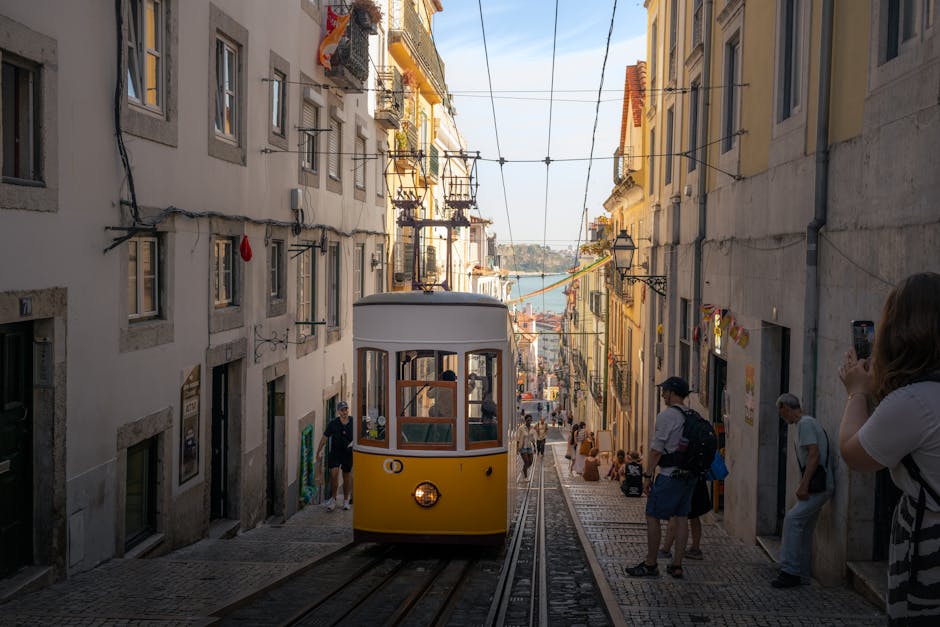
From there, the mood changes as you move toward Alfama, where the plan loosens into stairs, alleys, and sudden pockets of shade. This is the older Lisbon many travelers imagine, but it is more than atmosphere. The neighborhood’s form reflects a city shaped over centuries rather than rebuilt all at once, and that contrast between Baixa and Alfama is one of the clearest ways to understand Lisbon’s history while walking it. The famous yellow trams feel most at home here, not just as icons but as part of the city’s rhythm, scraping past corners that seem almost too narrow to hold them.
Food follows the same geography. In the flatter center, pastry counters and tiled cafes invite short pauses; farther uphill, the meal often slows down. First-timers do not need to chase every specialty, but Lisbon makes most sense when you try a few essentials in context: bacalhau in one of its many forms, grilled sardines when the season suits, and a pastel de nata still warm enough to soften the custard’s center. Guides aimed at new visitors often point to the city’s seafood, miradouros, and old quarters as the trio that defines a stay here, and that framing is broadly right (Wheatless Wanderlust; Lisbon.net).
As the streets climb, the reward is almost always a miradouro. You do not need to collect them all. One or two well-timed stops—looking over terracotta roofs, church domes, and the Tagus—usually explain the city better than a packed itinerary. Lisbon reveals itself through elevation: first the grid, then the maze, then the view that gathers everything into place.
). In traveler communities, that centrality comes up again and again because it keeps major walks, viewpoints, tram connections, and meal stops within reach rather than turning every outing into a transit puzzle.
Just as important is pace. Many popular itineraries and short-form travel posts frame Lisbon as a city of miradouros, pastries, tiled lanes, and golden-hour wandering, and that social consensus is useful: the city rewards unhurried movement. A morning in Alfama, for example, lands better when it includes pauses for small details and a long lunch, not only church-and-castle boxes ticked off in sequence. Guides for first-timers also tend to emphasize the same balance—history, food, and views together, rather than one at the expense of the others (Wheatless Wanderlust’s first-timer itinerary; Lisbon.net overview).
That balance matters because Lisbon is one of Europe’s most visited urban destinations, and it is easy to mistake popularity for a need to rush (Tourism in Lisbon). Most first-time visitors get the city right when they resist that urge: choose a central stay, walk the flatter stretches when you can, save energy for the climbs that lead to a view, and leave room for a seafood lunch, a coffee, or a late-afternoon pause above the river.
Baixa
belongs to the city rebuilt after the 1755 earthquake, while the surrounding hills still hold older patterns of lanes, stairs, and neighborhood life. For a first-time visitor, that contrast can feel clarifying rather than confusing. You are not expected to "complete" Lisbon. You are simply moving between versions of it: imperial and everyday, river-facing and hill-bound, polished and worn-in.
In practice, the most satisfying days are usually the ones with a little structure and plenty of slack. Choose one or two anchors, not six. Let lunch become part of the sightseeing. If you find a viewpoint that makes you want to stay longer than planned, stay. Much of Lisbon's pleasure comes from accepting the city's pace instead of negotiating against it. Even broad overviews of the capital tend to return to the same essentials—history, food, and views—not because the city is simplistic, but because those three threads are genuinely how Lisbon reveals itself best (Wikipedia overview; first-timer itinerary perspective).
That is also why a few well-paced days can feel more complete here than a frantic longer stay. You leave remembering not just monuments, but transitions: the shift from bright squares to steep alleys, from tiled facades to open water, from a quick espresso to a long sunset. For first-time visitors, that is reassuring news. Lisbon does not ask to be conquered. It asks to be read slowly, one neighborhood, one meal, one outlook at a time. If you allow for that, the city usually gives back something richer than efficiency: the feeling that you have not checked it off, but actually met it.