Top 5 Cities in France: An Editorial Guide to Art, Food, and Romance
Five cities, five distinct moods: a first look at the art, food, and romance that make urban France feel endlessly varied.
franceartguided_tour
An elegant first look at Paris for first-time visitors, shaped by river light, café terraces, stone façades, and the skyline icons that give the city its enduring pull.

Paris is easiest to love when you stop trying to finish it. For a first visit, it helps to think of the city not as a checklist of monuments but as a set of neighborhoods stitched together by bridges, boulevards, and long, walkable stretches of daily life. The grand landmarks matter, of course, but they land best when you allow room for the smaller Paris around them: a market street in the 5th, a quiet square in the Marais, the view that appears suddenly at the end of an avenue.
This is also a city of layers. Medieval lanes, 19th-century planning, revolutionary history, and modern cultural life sit almost on top of one another. Even places that look purely elegant often carry heavier stories beneath the surface; Place de la Concorde, for instance, is inseparable from the French Revolution. That depth is part of what makes Paris feel inexhaustible.
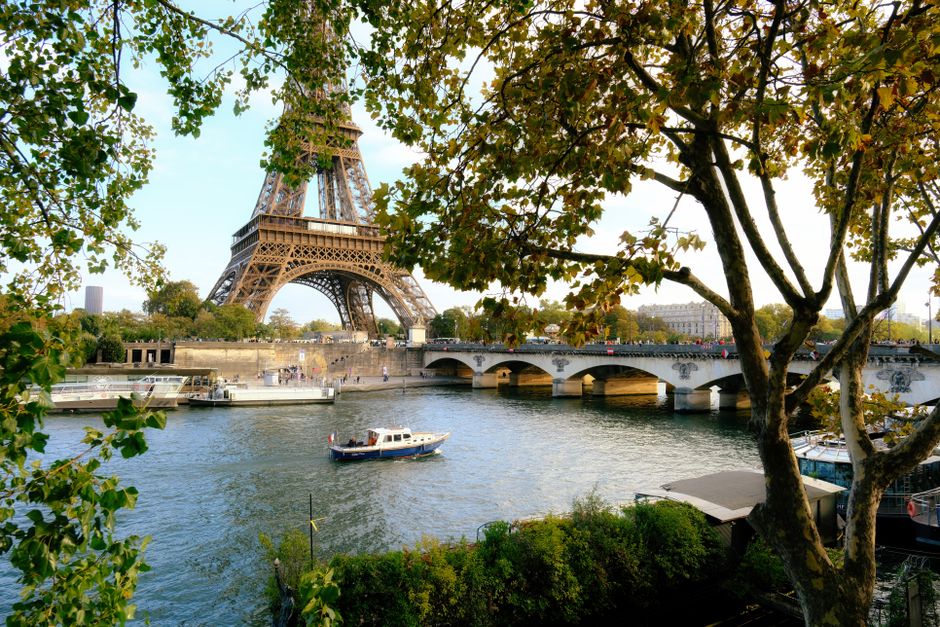
Stand beneath the Eiffel Tower once, then step away from it. For a first visit, Paris makes more sense when its icons are treated as anchors rather than errands: the tower for scale, the Seine for orientation, the Louvre area for grandeur, Montmartre for its hilltop mood, and the café for the daily ritual that turns sightseeing into city life.
Recent traveler posts are notably less interested in “doing Paris properly” than in letting the city unfold at a humane pace, and that instinct is a good one. Across current Instagram itineraries and TikTok advice, the first-timer patterns that feel smartest are also the least frantic: one headline landmark, one neighborhood with no fixed agenda, and enough room for a market, a café, or a river crossing to become part of the day.
That social evidence is strikingly consistent. A popular first-time reel frames a single day around “a nice mix of popular landmarks and some more local areas,” rather than a monument sprint, while another recent post praises a four-day plan built on art, food, strolls, skyline views, and “small moments” instead of nonstop sightseeing. Even the practical content points the same way: first-time Paris advice increasingly assumes that visitors can and should move confidently by Metro and RER, not just by taxi. Paris rewards that confidence; as guides such as
Paris is most generous when you stop trying to beat it. For a first-time visitor, that may be the most useful thing to remember at the end of all the planning: the city’s great sights matter, but they do not explain Paris on their own. The memory that lasts is often smaller and less scheduled—the moment a bridge gives you a new angle on the Seine, the quiet hour when a museum begins to feel human in scale, the meal that stretches long enough for the room to soften around you.
So yes, go to the icons. See the tower. Stand before the great collections. Walk the famous hills and boulevards. Paris has earned its reputation as a capital of art, food, and ideas, and that stature is part of what makes a first visit so electric, as even broad overviews such as
Based on: paris • guided_tour
Practically, first-timers do well here by walking as much as possible and using public transport to connect the bigger jumps. Paris is relatively compact, and its rhythm reveals itself at street level more than underground. Explore France notes the city’s strong rail links and wider regional connections, while guides like Rick Steves’ Paris overview capture how naturally art, food, and urban life meet here.
So begin with restraint. Choose a few major sights, leave space between them, and let the city assemble itself gradually. Paris rarely rewards conquest; it rewards attention.
Around the Louvre, resist the urge to do too much at once. This part of Paris can feel ceremonial: long façades, formal gardens, grand perspectives stretching toward Place de la Concorde and beyond. Even if you enter the museum, give equal value to the streets around it and to the pause that follows—perhaps a coffee taken standing at the bar in the morning, or later a glass of wine on a terrace. In Paris, meals and pauses are not filler between monuments; they are part of the visit.
Then there is Montmartre, where the city loosens. Yes, it draws crowds, especially near Sacré-Cœur, but a first trip should still allow time for its side streets, stairways, and small squares, where the village feeling survives the souvenir stands. Come early or near dusk, when the hill is gentler.
The smartest pacing is to pair one major sight with one neighborhood and one food ritual each day: a museum and a market street, a river walk and a long lunch, a hilltop view and an unhurried apéritif. Paris rewards that rhythm. It is a city best understood not by finishing it, but by letting its famous places lead you into its habits.
Just as telling is how often food now sits at the center of the day, not at its edge. Recent market-focused TikTok content speaks directly to travelers intimidated by Parisian food halls and neighborhood markets, gently reframing them as approachable rather than exclusive. For a first visit, that is exactly the right correction. A morning at a market, an unhurried lunch, or a pause for coffee on a lived-in street often leaves a sharper memory than forcing in one more museum room.
So the first-timer consensus is not to skip the icons. It is to soften them with ordinary pleasures: ride the Metro without drama, browse where locals shop, and let atmospheric streets do some of the work that monuments cannot.
That means leaving slack in the day on purpose. Cross one bridge without checking your phone. Give yourself a single museum hour with no ambition to “do” the whole institution. Accept that one careful lunch may tell you as much about Paris as another rushed landmark. Current traveler posts tend to get this right: the most appealing first-time itineraries now mix headline views with strolling, cafés, market browsing, and room for accident rather than treating the city as a timed exam.
Paris rewards attention. Look up at the façades before you enter the shop. Notice how one arrondissement gives way to another by rhythm as much as by map. Pause in a square whose beauty is inseparable from its history—something contemporary creators still point out when they remind visitors that places such as Place de la Concorde carry the weight of the Revolution as well as present-day elegance, as in this recent TikTok note on Concorde’s past.
If you leave Paris feeling that you missed something, that is not failure; it is the correct ending. The city is not designed to be completed in one trip, and first-time visitors are often happiest when they stop asking it to be. See what you came to see, certainly. But save an evening for a bridge crossing, an hour for a gallery room, and enough time for dinner to become part of the story. In Paris, pace is not the enemy of depth. It is how depth arrives.